
Is the Australian property market about to crash?
The property market is falling.
And if you’ve been watching the news and social media lately, you’d be forgiven for thinking the sky is falling too.
Everywhere you look there seems to be another headline about falling property prices.
Prices are down.
Auctions are struggling.
Investors are pulling back.
Interest rates could rise again.
And then someone at work tells you their mate reckons property is about to crash.
Before you know it, you’re thinking…
“Should I sell?”
“Should I stop investing?”
“Have I missed the boat?”
“Are we heading for another 2008?”
This is where I think it’s important to take a breath.
Because we have been here before.
Property prices falling isn't new.
What is new is how quickly the news can make us feel like something is happening everywhere, all at once.
The more we hear something, the more we believe it.
Then worry starts.
Then we make decisions.
And sometimes those decisions are made from fear rather than facts.
So let's look at what is actually happening.
Over the last 10 years, Australian property prices have had some pretty big tailwinds behind them.
There has been a shortage of homes.
Estimates suggest Australia has built up an accumulated housing shortfall of around 200,000 to 300,000 dwellings.
At the same time, population growth and immigration have increased demand for housing.
Then investor demand increased strongly after 2020.
More people wanting property + not enough property to go around = higher prices.
But now some of those forces are moving in the opposite direction.
Interest rates are higher.
Mortgage repayments are higher.
The cost of living is putting pressure on household budgets.
Property is becoming harder to afford.
Investor demand is being affected by proposed changes to property tax concessions.
And perhaps most importantly…
Confidence has fallen.
When people are worried about the economy, interest rates and their own household budget, they become much more cautious about making a $700,000 or $1 million decision.
And we are starting to see that in the numbers.
But here's the part I think gets missed.
Property prices have fallen before.
A lot of times.
The chart below shows some of the major property downturns Australia has experienced over the years.
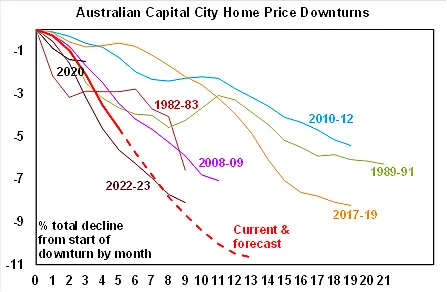
We have seen property prices fall in the past.
The difference this time is that some economists believe the current downturn could be deeper than some of the more recent falls.
Shane Oliver, for example, is forecasting around a 6% fall in property prices over this calendar year and an 8% fall over the current financial year.
He expects capital city prices could fall around 11% from their peak to their trough.
Some areas could fall more than that.
Brisbane, Adelaide, Sydney and Hobart houses are currently considered more vulnerable, while Brisbane, Adelaide and Canberra units are considered more exposed.
But here's the really important bit.
A fall in property prices does not automatically mean a property crash.
For a 20%+ crash to occur, we would normally need a lot of people to be forced to sell.
Think about it like this.
If you own a house and its value falls 10%, but you can comfortably pay your mortgage and don't need to sell…
You don't have to sell.
The price can fall on paper without you being forced to crystallise the loss.
This is one of the reasons unemployment matters so much.
Australia's unemployment rate is around 4.5%.
Compare that with countries such as New Zealand and Canada, where unemployment has been considerably higher (5.5%+) during their larger property falls (by 15%-20%)
So while I think there are genuine reasons to expect property prices to weaken further, I'm not sitting here thinking every Australian house is about to lose 20% of its value.
There is a big difference between a property downturn and a property crash.
And here's where I think things get interesting.
Times like this create opportunities too.
First home buyers may finally get a little more breathing room.
Investors who have been priced out for years may find better opportunities.
And people who have strong cashflow, savings and borrowing capacity can sometimes make decisions when everyone else is frozen.
But only if the foundations are right.
This is the bit I keep coming back to with clients.
Don't try to predict the bottom.
Don't try to predict the top.
And definitely don't make a major financial decision because a bloke at the pub told you property is going to crash.
Instead, ask better questions.
Can I comfortably afford the debt?
Do I have a cash buffer?
What happens if interest rates rise again?
What happens if the property falls 10%?
What happens if I don't sell?
Does the property still make sense over 10 or 15 years?
And most importantly…
Does it fit my overall financial plan?
Because property isn't a 12-month investment.
It's a long game.
History shows us that Australian property has experienced plenty of downturns along the way, while also producing strong long-term growth.
But that doesn't mean property prices only go up.
They don't.
And anyone telling you they do is selling you a story.
The lesson isn't to ignore what's happening.
It's to understand what's happening without letting it control you.
The media will always turn the dial up.
That's their job.
Your job is different.
Your job is to make sure your financial foundations are strong enough that you don't have to make emotional decisions when the market gets uncomfortable.
Have your buffers.
Understand your debt.
Know your cashflow.
Know what you own and why you own it.
Then, when opportunities appear, you can actually take advantage of them.
Because opportunities are everywhere when you're prepared.
And sometimes the best investment decision isn't doing something.
It's simply having the confidence to do nothing while everyone else is panicking.
Think long term.
Stay prepared.
And don't let the headlines make your financial decisions for you.
Reading is helpful. Having a plan is better.
Book your free 30-minute Discovery Session and let’s build a strategy that fits your life.
7Wealth Pty Ltd ABN 44609210246 is a Corporate Authorised Representatives and is authorised throughCobalt AdvisersPty Ltd ABN 64 628 654 099 who is an Australian Financial Services Licensee 512550. 7Wealth Pty Ltd is a Credit Representative ofAustralian Finance GroupLtd ABN 11 066 385 822 (AFG) Australian Credit Licence 389087.
This blog contains information that is general in nature. It does not constitute financial or taxation advice. The information does not take into account your objectives, needs and circumstances. We recommend that you obtain investment and taxation advice specific to your investment objectives, financial situation and particular needs before making any investment decision or acting on any of the information contained in this document. Subject to law, Cobalt Advisers Pty Ltd nor their directors, employees or authorised representatives, do not give any representation or warranty as to the reliability, accuracy or completeness of the information; or accepts any responsibility for any person acting, or refraining from acting, on the basis of the information contained in this document.

