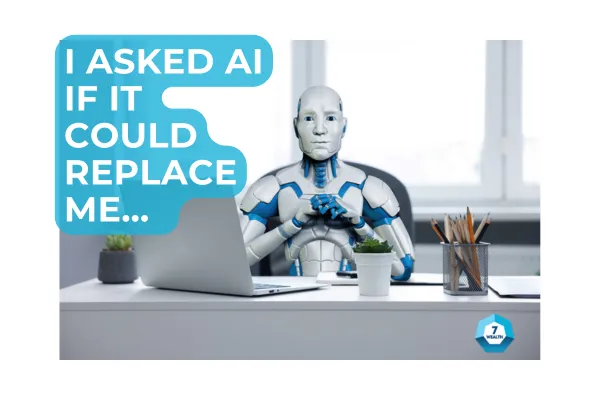
Is AI going to take my job?
A robot is taking my job.
Well… maybe.
And honestly, I think that’s a good thing.
AI is changing almost every industry, including financial advice.
And it’s already changing the way Australians think about their money.
New research found that 35% of Australians have already used AI to get information about their super or retirement.
Another 32% would consider using it.
And interestingly, the people using it most aren’t necessarily young people.
They’re middle-aged, working Australians with families and often more than $100,000 in super.
In other words, people with a lot at stake.
That means this isn't some futuristic idea.
It’s already happening.
And I completely understand why.
You can open your phone at 10pm and ask:
“How much super do I need to retire?”
“What should I invest in?”
“Should I salary sacrifice?”
“Should I pay off my mortgage or invest?”
And within seconds, you get an answer.
That’s pretty incredible.
But here’s where it gets interesting.
Only 22% trust or strongly trust the accuracy of AI-generated super and retirement information.
A further 29% actively distrust it.
And 71% of Australians are concerned about privacy and security when using AI for financial information.
Despite the surge in AI usage, 69% say they would rather speak to a person than use AI for financial information.
And there’s a good reason for that.
A study published in the Journal of Financial Planning tested seven AI platforms on retirement advice and found significant variation, inaccuracies and in some cases, bias.
In their testing, AI hallucinated answers nearly 1 in 3 times.
That means it can confidently give you an answer that sounds right…
…but isn't.
And there’s another really important difference.
A financial adviser has legal obligations to act in your best interests.
None.
So am I worried about AI replacing financial advisers?
Not really.
Because there is a big difference between getting an answer…
…and getting advice.
AI is incredibly good at information.
It can crunch numbers.
Find information.
Build scenarios.
Spot patterns.
Challenge ideas.
And give you an answer in seconds.
But money isn't just information.
Money is emotional.
Imagine a client jumps on a video call with me after their investment portfolio has fallen 10%.
They’re worried.
They’re asking whether they should sell before things get worse.
AI can explain why markets have fallen.
It can show historical data.
It can calculate different scenarios.
But it can't look at the person on the screen and notice that they're scared.
It doesn't know they've been working towards retirement for the last 10 years.
It doesn't know their partner is sitting beside them and is even more worried.
And it certainly doesn't know whether selling today is actually the right decision for their personal plan.
That’s where the human part matters.
Good financial advice isn't just about finding the mathematically correct answer.
It's about finding the right answer for the person.
Their goals.
Their family.
Their values.
Their fears.
Their behaviour.
Their circumstances.
And sometimes…
it's about stopping someone from doing something silly when they're emotional.
That might be one of the most valuable parts of the job.
But here’s the part I think is really exciting.
I don't see AI and financial advisers as competitors.
I see them as a team.
I use AI myself.
Every week.
It helps me research, challenge ideas, analyse information, write and look at things from different angles.
Think of AI like having a ridiculously smart assistant sitting beside me.
It can do the heavy lifting.
But I'm still the person asking:
“Does this actually make sense for this client?”
“What are we missing?”
“What happens if things don't go to plan?”
“Is this right for them?”
And most importantly:
“What matters to them?”
That’s the difference.
AI can help us make better decisions.
But it shouldn't be the one making your decisions for you.
Because sometimes the best financial decision isn't the one that looks best on a spreadsheet.
It's the one that lets you sleep better at night while still getting you where you want to go.
So yes…
AI might take some parts of my job.
And I'm completely okay with that.
If it means I spend less time doing boring stuff and more time helping people make better decisions with their money…
Bring on the robots.
The future of financial advice probably isn't:
Human vs AI.
It’s:
Human + AI.
And I think that's a pretty exciting future.
Although, if you're wondering which jobs might be harder for AI to replace…
I’d be putting my money on the trades.
It’s pretty hard for a robot to crawl under a house, fix a leaking pipe, climb onto a roof or turn up at your front door at 7am with a toolbox.
So maybe the kids should forget about becoming financial advisers and become electricians instead...
Reading is helpful. Having a plan is better.
Book your free 30-minute Discovery Session and let’s build a strategy that fits your life.

